Sorry this post took so long to come out, but i have been quite busy the past few days, not even looking at comments on my last post.
anyways, a few questions answered, as i always start with:
"[blah blah..] suspension made of aluminum?"
no it is not, if it was it would be far too flexible, and would bend, re-bend, and eventually break, and be expensive to replace. if we were to make it out of aluminum it would be of a different design so it would use the flexibility as an advantage.
"[blah blah...] how do i replace" (paraphrased a few comments into one question)
you would buy a suspension kit that is compatible with your car, or suspension type, and fit it accordingly. then you would basically remove all the original components, that you have something new to replace with, and bolt up the new system...it is pretty straight forward, and a afternoon job.
"suspension doesnt work, [blah blah...] tires should be all rubber [blah]"
keep in mind the amount of forces that suspension goes through on just a stroll up the street. you have acceleration pushing the weight towards the back, stopping doing the opposite, and turning doing something similar. if suspension was alot softer, you would think it 'works' better, but it is impractical for more damaging impacts, like a pothole, or going too fast over a speed bump. One way around this is making more suspension travel, which would just make the car want to flip, and harder to get into, and more impractical.
the best workaround is for the suspension to be relatively stiff, and a bit low, as it is now.
as for tires, they are how they are for many reasons.
For starters, they do make tires with no air, just rubber...they are called 'run flat' tires, mainly used by special police forces, and army ect.
Secondly, the weight of a solid rubber tire is insane, it is like rolling a boulder, and it is also using alot of rubber, which is bad for the environment. Due to the weight, the rolling resistance of this is much higher, increasing acceleration times, and making stopping much harder.
tires have a optimal operating temperature, and when exceeded will take longer to cool. when too cold it will take longer to heat.
depending on the application, you might need to ajust pressure. in the snow you want a higher pressure, so you can have a smaller footprint, and for sand you want a much lower footprint to get a larger footprint. the only way to control this is air, so rubber will not let this happen.
under driving forces (seen every day, as-well) the tire takes alot of the impact of the road, such as pot-holes, small bumps, and cornering.
without the tire flexing, the suspension will seemingly work even less then you already claim.
tl;dr, just look at this clip from my favorite game, a racing simulator...it is true to life, and sum's it up pretty well. pay attention to the suspension over every bump, and the tires during corners and bumps.
anyways, now about the ACTUAL post ^^
So adjustments that effect driving, performance, tire wear, reliability ect. include simple things that make a world of difference both on the edge, and normal driving. (all can be played with in the simulator i mentioned eariler, called 'Live for speed', seen at lfs.net
So to start, i will mention compression ratio, or the force it takes for the suspension to actually move at all. If you run over an ant it will not effect the suspension enough to move the suspension, but a bolder will. The amount of force required cannot be overlooked.
for street you want something soft enough for comfort, and to reduce shock on the car, and stiff enough to be able to take a beating.
on track you want something to allow the weight to transfer, but stiff to give a solid feel, without bottoming out. race cars have very stiff suspension.
relating to above, is dampening, and rebound dampening. dampening is the force holding the spring from doing repetitive motion after a bump. dampening is compression resistance, and rebound dampening is resistance of the spring unloading.
you want the suspension to do its job, then when the job is done return, nothing more, nothing less. you want these to be a bit soft for road, and for track, and bit harder.
sway bars. on the street, these tend to be soft because you may have to do street driving one day, and the next be on somewhat rough terrain. sway bars kill you off road.
on a track, you want enough sway bars to let the car stay very level during corners, but still transfer weight. too much sway bar will promote traction loss.
ride height is just basically as low as what above will allow.
now we have gone over what stays constant while driving, now what changes as you go.
camber: the angle of the wheel to the ground, for softer suspension (road) you want a positive number, to ensure the inner wheel is doing about as much work as the outer wheel. for track you want a negative number to allow the outer wheel to do as much work as possible, as that is where the weight is.
Toe, another adjustment is typically only used on the track, depending on the car. this promotes tire wear. positive toe-in would make a car more stable, and negative toe-in would make a car corner better, and feel more lively.
(not limited only to front wheels)
parallel steer, or Ackerman. this is how parallel the wheels stay while being steered, the more parallel the more the rear will want to slide out, the less parallel the more grip around the corner, and less tire wear.
the reason for this is the inside wheel takes a smaller radius turn, and should follow this path
track is the width in between the wheels, typically the more width the more stable, and therefore more grip.
caster is the angle of the wheel as you turn (camber of wheel as you turn). the reason of this is as you turn, the car might lean to one way, changing the contact patch.
(this is the best picture showing it i could find, notice the wheel changes angle due to the turn)
scrub is the amount the tire is pushing due to one of these adjustments changing the way it rolls, none is ideal, but some is going to happen.
modifications of these are just adjustments, and different types of suspension swaps, and different coil-overs, or maybe different ride heights.
motorcycles have usually just a control arm on each side of the back wheel, and the front just has forks.
each side of the forks goes to a side of the wheel, and a spring is attached to add resistance.
the back has 2 pivot points on each side of the rear of the frame which you attach each control arm, and each one goes to a side of the wheel. those 2 connect and a coil-over is attached.
adjustments of these are length of control arms, length of forks, and strength of coilover's and resistance.
like i said i am not very knowledgeable in the motorcycle field.
as always, comment, and ask any questions, they all get answered!
next time i might mention brakes a little bit, feedback please!
Sunday, April 3, 2011
Saturday, March 26, 2011
suspension stuff
Ok, first off id like to thank you guys for having me do this...i learned alot myself researching this.
To the guy with the suzuki, i would start off finding the air filter, usually under the seat, or towards the front of the engine. open that up, check to see if the filter needs replacing, and just follow that until you find a little box with some fuel lines coming to it. shut off the fuel (if there is a valve) and remove the fuel lines, not much fuel should spill out. remove the box, and take it apart being very careful not to lose parts, and to keep track of where everything went. clean everything thoroughly and put it back.
consider getting a "carb kit" for it, to help you out.
hope i diddnt miss any questions.
So about suspension. There are quite a few types, and all are different for certain applications of your vehicle.
lets start out simple (with cars, cause thats what i made the blog with the intentions of)
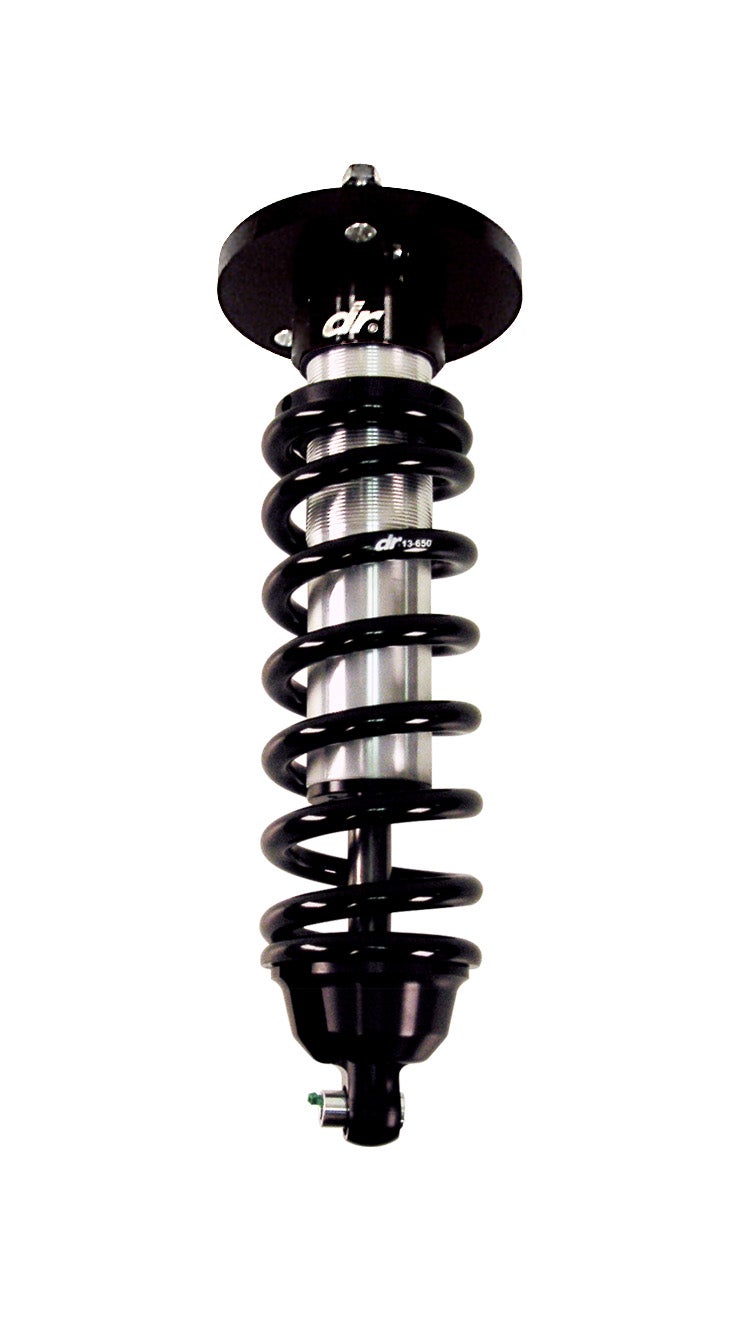
There is a part that most suspension units have, and what most people think of when they think of "suspension", this is the coil over. Basically a spring over a shock absorber. looks like the picture below. What it does is it provides resistance, yet ability for movement, all while preventing a pendulum effect, or stopping movement after the job is done.
the spring is the main resistance, and the shock (on the inside) dampens it.
many suspension types include this somewhere in their design, quite a fool proof design.
Now that we got the backbone for most suspension out of the way, lets start with the most simple suspension design, which ironically does not include the coilover.
The leaf spring suspension is one of the most common types, but also the most simple. You simply have a few slabs of metal clamped together that flex as a form of movement. This is classified as "dependent" because both wheels basically use the same unit. there is a solid axle that both wheels are attached to, then they are connected to one of these on each side, but as one goes up, the other will be at a different angle to the road, and might drive weird. trucks commonly have this, but cars almost never do.
as you can see, very basic, and not the best as a result.
with the solid axle idea, you can also replace it with a coil over, but it is more common for a leaf spring.
that is the basic idea of a dependent system, how about an independent system?
almost all cars have independent suspension systems, and their design is a bit more complicated.
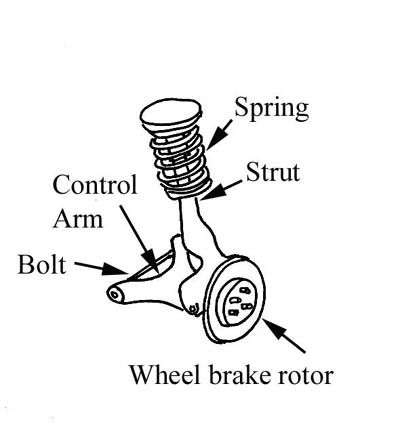
the mcpherson strut is essentially the most straight forward independent system. you connect the wheel to the hub (what holds the wheel) and that is connect to a top and bottom piece.
the top piece is basically just made up of a coilover, but the bottom is connected to the frame, and holds most of the weight. we call the bottom piece the lower control arm, and it holds most of the weight, and force in this design.
as this is one of the most fool-proof designs of independent suspension, there are a few modifications to this design, some just moving the spring, and the angle, others tweaking the general idea.
another type is a double wishbone type suspension. This has the same idea of a top piece, and a bottom piece, called control arms.
one type of double wish bone has both control arms in the shape of a wish-bone (no way!), and the lower control arm has the coilover attached to it, with the upper control arm acting as reinforcement.
An alternative to this, is instead of the lower control arm being a wishbone shape, it is a single bar, and the upper control arm has the coilover attached to it. this transfers the load from the lower control arm, to the upper control arm.
a little less advanced is something called the "trailing arm" system. im going to be honest and i cant wrap my head around this. your upper and lower control arms are pieces of metal running parallel to the wheel, and attach to the chassis. the lower and upper control arms are parallel, and the lower carries the spring. *looks at picture one more time and figures out concept*
ok, now the end of the control arms attached to the wheel are attached to ball joints, and the other ends are pivot points. the allows for the wheel to move.
other components to suspension are such as sway bars, and...well thats the major one.
a sway bar just links the two sides of independent suspension together, making them move more as one, to...well...limit sway of the body.
interesting things i found during my research:
corvette uses a fancy suspension type that when first invented, was AWFUL, and hard to control, and just stupid.
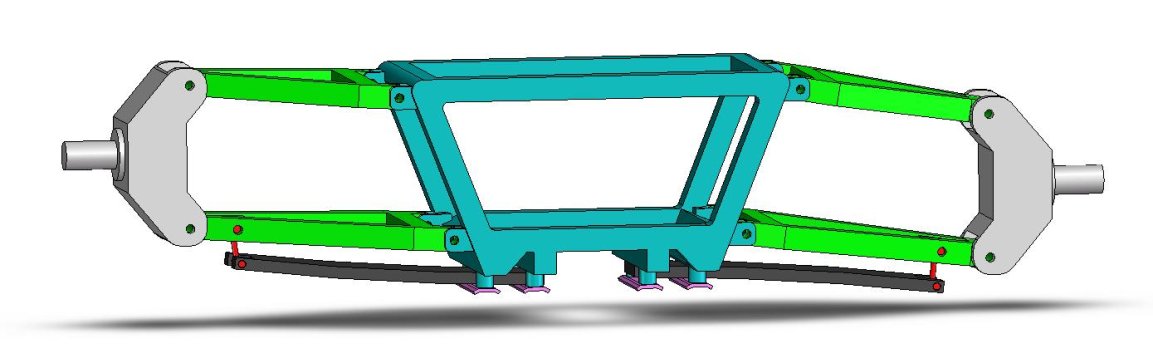
this design combines the leaf spring idea, with the double wishbone design. (the one pictured below)
instead of the coilover being mounted to the lower control arm, just a shock absorber is mounted, and on the lower side of the lower control arm, is a leaf spring attached. this leaf spring runs along the bottom of the car, and the other end is attached to the other lower control arm.
after a little further research on this, it appears that the leaf spring in the corvettes are split in the middle, which gets rid of the problems of the original design.
the problem with the original design was under heavy braking, or a very sharp corner, the leaf spring would go to its unloaded position and i guess just make the car's contact with the road very little, and something like this would happen?
this took alot of thinking and research, and this post took about 2 hours to type..please enjoy haha
next post will be about the ajustments, modifications, and geometry of this whole setup, including but not limited to camber, caster, toe, scrub, and we will include some info on racing setup's.
Comment with any questions! :)
To the guy with the suzuki, i would start off finding the air filter, usually under the seat, or towards the front of the engine. open that up, check to see if the filter needs replacing, and just follow that until you find a little box with some fuel lines coming to it. shut off the fuel (if there is a valve) and remove the fuel lines, not much fuel should spill out. remove the box, and take it apart being very careful not to lose parts, and to keep track of where everything went. clean everything thoroughly and put it back.
consider getting a "carb kit" for it, to help you out.
hope i diddnt miss any questions.
So about suspension. There are quite a few types, and all are different for certain applications of your vehicle.
lets start out simple (with cars, cause thats what i made the blog with the intentions of)
There is a part that most suspension units have, and what most people think of when they think of "suspension", this is the coil over. Basically a spring over a shock absorber. looks like the picture below. What it does is it provides resistance, yet ability for movement, all while preventing a pendulum effect, or stopping movement after the job is done.
the spring is the main resistance, and the shock (on the inside) dampens it.
many suspension types include this somewhere in their design, quite a fool proof design.
Now that we got the backbone for most suspension out of the way, lets start with the most simple suspension design, which ironically does not include the coilover.
The leaf spring suspension is one of the most common types, but also the most simple. You simply have a few slabs of metal clamped together that flex as a form of movement. This is classified as "dependent" because both wheels basically use the same unit. there is a solid axle that both wheels are attached to, then they are connected to one of these on each side, but as one goes up, the other will be at a different angle to the road, and might drive weird. trucks commonly have this, but cars almost never do.
as you can see, very basic, and not the best as a result.
with the solid axle idea, you can also replace it with a coil over, but it is more common for a leaf spring.
that is the basic idea of a dependent system, how about an independent system?
almost all cars have independent suspension systems, and their design is a bit more complicated.
the mcpherson strut is essentially the most straight forward independent system. you connect the wheel to the hub (what holds the wheel) and that is connect to a top and bottom piece.
the top piece is basically just made up of a coilover, but the bottom is connected to the frame, and holds most of the weight. we call the bottom piece the lower control arm, and it holds most of the weight, and force in this design.
as this is one of the most fool-proof designs of independent suspension, there are a few modifications to this design, some just moving the spring, and the angle, others tweaking the general idea.
another type is a double wishbone type suspension. This has the same idea of a top piece, and a bottom piece, called control arms.
one type of double wish bone has both control arms in the shape of a wish-bone (no way!), and the lower control arm has the coilover attached to it, with the upper control arm acting as reinforcement.
An alternative to this, is instead of the lower control arm being a wishbone shape, it is a single bar, and the upper control arm has the coilover attached to it. this transfers the load from the lower control arm, to the upper control arm.
a little less advanced is something called the "trailing arm" system. im going to be honest and i cant wrap my head around this. your upper and lower control arms are pieces of metal running parallel to the wheel, and attach to the chassis. the lower and upper control arms are parallel, and the lower carries the spring. *looks at picture one more time and figures out concept*
ok, now the end of the control arms attached to the wheel are attached to ball joints, and the other ends are pivot points. the allows for the wheel to move.
other components to suspension are such as sway bars, and...well thats the major one.
a sway bar just links the two sides of independent suspension together, making them move more as one, to...well...limit sway of the body.
interesting things i found during my research:
corvette uses a fancy suspension type that when first invented, was AWFUL, and hard to control, and just stupid.
this design combines the leaf spring idea, with the double wishbone design. (the one pictured below)
instead of the coilover being mounted to the lower control arm, just a shock absorber is mounted, and on the lower side of the lower control arm, is a leaf spring attached. this leaf spring runs along the bottom of the car, and the other end is attached to the other lower control arm.
after a little further research on this, it appears that the leaf spring in the corvettes are split in the middle, which gets rid of the problems of the original design.
the problem with the original design was under heavy braking, or a very sharp corner, the leaf spring would go to its unloaded position and i guess just make the car's contact with the road very little, and something like this would happen?
this took alot of thinking and research, and this post took about 2 hours to type..please enjoy haha
next post will be about the ajustments, modifications, and geometry of this whole setup, including but not limited to camber, caster, toe, scrub, and we will include some info on racing setup's.
Comment with any questions! :)
Thursday, March 24, 2011
answering a few questions before my poll finishes up
**IF YOU HAVE NOT DONE THE POLL, PLEASE DO THAT, JUST TO THE RIGHT!**
Anyways, i thought i would just answer any questions i gathered by looking at you guys' comments.
1. What is a good dirt-bike for a beginner/price for one?
Well it all depends on how big you are, and how much you know about riding something you have to shift yourself. If you are still growing, it is best to just stick to something below 125cc four stroke, and 100cc two stroke (2 stroke is always more powerful, and difficult).
I would go to a dealership, and talk to a salesman, or perhaps respond to some local ad's to try to find something you can deal with.
If you are fully grown, and are just starting, you should stick to 125-250cc 4 stroke, and 85-125cc 2 stroke (both KILLER sizes).
if you do not know how to PROPERLY operate a manual gearbox, with the clutch, then comment and il get a nice guide up.
if you dont know how, you are limited to a very small sized dirtbike.
for any beginner i would get something used, but in good condition. depending on year and size i would pay no more then $2250. I could get a very nice beginner bike for $1500, but the condition might not be the best.
2. What are those mini-bikes (pit-bikes) about?
They are smaller, lighter, more stunt oriented bikes with oversized engines in them, and they (i imagine) are pretty scary.
they are just a different type of riding, and i would not take them very far on the trails (smaller wheels = not going over everything easily)
3. pictures of my bikes?
Im going to try to get you guys some pictures, but one is not at my house, and the other two are in my basement (dark), so no action shots :(
until the poll results come in (still a few hours left) im not going to start going over anything. so if you have not voted, please do so.
im going to try to extend that to a better time...right now it ends in the middle of the night here.
comment with any questions that are car or bike related!!
Anyways, i thought i would just answer any questions i gathered by looking at you guys' comments.
1. What is a good dirt-bike for a beginner/price for one?
Well it all depends on how big you are, and how much you know about riding something you have to shift yourself. If you are still growing, it is best to just stick to something below 125cc four stroke, and 100cc two stroke (2 stroke is always more powerful, and difficult).
I would go to a dealership, and talk to a salesman, or perhaps respond to some local ad's to try to find something you can deal with.
If you are fully grown, and are just starting, you should stick to 125-250cc 4 stroke, and 85-125cc 2 stroke (both KILLER sizes).
if you do not know how to PROPERLY operate a manual gearbox, with the clutch, then comment and il get a nice guide up.
if you dont know how, you are limited to a very small sized dirtbike.
for any beginner i would get something used, but in good condition. depending on year and size i would pay no more then $2250. I could get a very nice beginner bike for $1500, but the condition might not be the best.
2. What are those mini-bikes (pit-bikes) about?
They are smaller, lighter, more stunt oriented bikes with oversized engines in them, and they (i imagine) are pretty scary.
they are just a different type of riding, and i would not take them very far on the trails (smaller wheels = not going over everything easily)
3. pictures of my bikes?
Im going to try to get you guys some pictures, but one is not at my house, and the other two are in my basement (dark), so no action shots :(
until the poll results come in (still a few hours left) im not going to start going over anything. so if you have not voted, please do so.
im going to try to extend that to a better time...right now it ends in the middle of the night here.
comment with any questions that are car or bike related!!
Wednesday, March 23, 2011
answering a few questions, and
About bikes, im not too sure about road bikes for beginners, because i have dirt-bikes. I can recommend some good yamaha beginner bikes for people, depending on experience, and age, but when it comes to road bikes im clueless.
i have 3 dirtbikes, all yamaha.
One is a TTR-90, i am trying to sell it, because i out-grew it, comment if interested, i am based around Boston Massachusetts (thats in USA).
i moved up from the 90 to a TTR-125L. this is the nicest 125, no electric start, which i like, and it has a front disk brake. very nice trail bike for anybody.
after that i got my need for speed...i ended up with a 2-stroke YZ-85. this is a killer bike for anybody, and i am also trying to sell this.
COMMENT if you want me to go over the difference between a 2-stroke engine and a 4-stroke engine. if anyone is interested i will point it out.
So the crank-shaft that the engine spins as a result of the pistons moving ends up going in two directions (like anything, it goes one way, and it has 2 ends, so it can go another way too). so one end of the rod the engine spins goes to the drivetrain, the other end goes to something called a torque converter.
What this does, is it takes the engine's power, usually whats just being wasted, and it spins a little generator, this generator is hooked up to the battery, which in turn charges it! When you turn something on like the heat, radio, AC ect. it ends up taking power from the battery. not quite rocket science haha
the engine gets its heat from friction, and then you turn a little fan on, and BOOM heat to you.
DONT FORGET TO DO THE POLL ------>
i have 3 dirtbikes, all yamaha.
One is a TTR-90, i am trying to sell it, because i out-grew it, comment if interested, i am based around Boston Massachusetts (thats in USA).
i moved up from the 90 to a TTR-125L. this is the nicest 125, no electric start, which i like, and it has a front disk brake. very nice trail bike for anybody.
after that i got my need for speed...i ended up with a 2-stroke YZ-85. this is a killer bike for anybody, and i am also trying to sell this.
COMMENT if you want me to go over the difference between a 2-stroke engine and a 4-stroke engine. if anyone is interested i will point it out.
So the crank-shaft that the engine spins as a result of the pistons moving ends up going in two directions (like anything, it goes one way, and it has 2 ends, so it can go another way too). so one end of the rod the engine spins goes to the drivetrain, the other end goes to something called a torque converter.
What this does, is it takes the engine's power, usually whats just being wasted, and it spins a little generator, this generator is hooked up to the battery, which in turn charges it! When you turn something on like the heat, radio, AC ect. it ends up taking power from the battery. not quite rocket science haha
the engine gets its heat from friction, and then you turn a little fan on, and BOOM heat to you.
ask any questions you have about bikes you want me to explain.
Tuesday, March 22, 2011
motorcycles
To the guy who was wondering if i knew anything about motorcycles, yes i know a bit being a dirtbiker, and cyclist myself.
what exactly do you want to know? most is the same, you have the engine, works around the same principle, just setup a little different, a smaller gear box, a frame, wheels brakes, and sometimes a few luxuries in between.
if you are interested in more about motorcycles then type "~motorcycle" in your post somewhere...now i have to ask, what do you want me to go over next? (ask any questions at any time, also)
-suspension
-drivetrain (where the power goes after the engine produces it ect.)
-wheels, tires, and geometry around that in general
-how your engine powers your heat, ac, sunroof, radio, recharges your battery ect.
Il take any other suggestions you want!
EDIT: MAKE A VOTE IN MY POLL TO THE RIGHT!
what exactly do you want to know? most is the same, you have the engine, works around the same principle, just setup a little different, a smaller gear box, a frame, wheels brakes, and sometimes a few luxuries in between.
if you are interested in more about motorcycles then type "~motorcycle" in your post somewhere...now i have to ask, what do you want me to go over next? (ask any questions at any time, also)
-suspension
-drivetrain (where the power goes after the engine produces it ect.)
-wheels, tires, and geometry around that in general
-how your engine powers your heat, ac, sunroof, radio, recharges your battery ect.
Il take any other suggestions you want!
EDIT: MAKE A VOTE IN MY POLL TO THE RIGHT!
Monday, March 21, 2011
quick about octane
i get a few questions like these, and i just want to clear a few things up. il be as informative as i know.
octane, as i said before, is the resistance to ignite. so this means the higher the octane the later in the piston's cycle it will ignite...so more compression is possible, and this means better performance, and power produced.
so for an engine, perhaps lower octane is more practical, but if you want anymore power without breaking the bank, higher octane will have to do.
octane, as i said before, is the resistance to ignite. so this means the higher the octane the later in the piston's cycle it will ignite...so more compression is possible, and this means better performance, and power produced.
so for an engine, perhaps lower octane is more practical, but if you want anymore power without breaking the bank, higher octane will have to do.
Brief note about engine modification
Ok, so as a few comments, and suggestions have wondered, i will make a post about modification.
so engines function is obviously to power the car, and essentially just move the wheels. (with a few side functions like heat, power ect.)
to keep it simple, think..how will this improve my engine. will it help apply more pressure to the piston for a greater explosion? will it help everything run smoother, or with less resistance? will it make stuff last longer?
turbo's like i mentioned add more pressure to pistons aiding a greater explosion of fuel. you can purchase a turbo that is designed for an engine like yours, and fit it with no issues. this is a popular addition.
other things to consider is an exhaust to give less resistance to the engine, a better filter, or intake to give cleaner, or more air to the engine (one of the key components to burn fuel).
how about what gives the engine fuel? you could add a better fuel injector, or perhaps a new engine computer that is programmed for power instead of economy.
all in all filters, and intakes are a very good place to start. after that i would go for injectors, and components of such.
modern engines are controlled almost completely by an ECU, or the engines computer/brain.
if you want to maximize performance then this is not a place to skip. it controls when fuel is given, and how much is.
i am not very knowledgeable in the modification area, so i apologize if not all of this is completely accurate, or good advice.
how would everyone like to hear about suspension next? transmissions? any questions?
comment below!
so engines function is obviously to power the car, and essentially just move the wheels. (with a few side functions like heat, power ect.)
to keep it simple, think..how will this improve my engine. will it help apply more pressure to the piston for a greater explosion? will it help everything run smoother, or with less resistance? will it make stuff last longer?
turbo's like i mentioned add more pressure to pistons aiding a greater explosion of fuel. you can purchase a turbo that is designed for an engine like yours, and fit it with no issues. this is a popular addition.
other things to consider is an exhaust to give less resistance to the engine, a better filter, or intake to give cleaner, or more air to the engine (one of the key components to burn fuel).
how about what gives the engine fuel? you could add a better fuel injector, or perhaps a new engine computer that is programmed for power instead of economy.
all in all filters, and intakes are a very good place to start. after that i would go for injectors, and components of such.
modern engines are controlled almost completely by an ECU, or the engines computer/brain.
if you want to maximize performance then this is not a place to skip. it controls when fuel is given, and how much is.
i am not very knowledgeable in the modification area, so i apologize if not all of this is completely accurate, or good advice.
how would everyone like to hear about suspension next? transmissions? any questions?
comment below!
Subscribe to:
Posts (Atom)